Product Highlights
- Ultra-Wideband: 50 GHz – 2.5 THz in a single device
- Higher Sensitivity than pyroelectric detectors
- Faster Response than Golay-Cell detectors
- Compact and low power
- Room-temperature operation
Application Areas
- THz Imaging Systems
- Fast THz Screening
- THz Spectroscopy
- Lab-based Responsivity Testing
- Industrial Power Detection
3DL 12C LS2500 A1 / A1M
The 3DL 12C LS2500 A1 is ACST’s most sensitive quasi-optical detector. It features a low-noise Schottky diode, a preamplifier with 1 MHz bandwidth, and is ideal for applications where maximum responsivity is required. For users needing higher bandwidth, the A1M variant extends the amplifier range to 40–50 MHz. While A1M has slightly reduced responsivity and increased noise, it retains the same compact design and ease of integration.
Both models operate at room temperature and offer reliable DC-coupled detection of THz signals, making them excellent for research, spectroscopy, and system-level monitoring
Type 3DL 12C LS2500 A1
| Parameter | Specification |
|---|---|
| Lens Type | Silicon; spherical; collimating |
| Lens Diameter [mm] | 12 |
| Antenna Type | Log-spiral |
| Antenna Bandwidth [GHz] | 50 – 2500 |
| Video Amplifier Bandwidth [Hz] | 10 Hz – 1 MHz (DC-Coupled) |
| Responsivity [V/W] | 22000 @70 GHz; 1100 @1 THz |
| Output Voltage [V] | ± 3 |
| NEP [pW/Hz^1/2] | 6 |
| Power Supply Output [V] | ± 12 |
| Current Consumption [mA] | 40 |
| Responsivity Measured at [ºC] | 24 |
Type 3DL 12C LS2500 A1M
| Parameter | Specification |
|---|---|
| Lens Type | Silicon; spherical; collimating |
| Lens Diameter [mm] | 12 |
| Antenna Type | Log-spiral |
| Antenna Bandwidth [GHz] | 50 – 2500 |
| Video Amplifier Bandwidth [Hz] | 10 Hz – 50 MHz (DC-Coupled) |
| Responsivity [V/W] | 3500 @70 GHz; 100 @1 THz |
| Output Voltage [V] | ± 0.3 |
| NEP [pW/Hz^1/2] | 15 |
| Power Supply Output [V] | ± 12 |
| Current Consumption [mA] | 30 |
| Responsivity Measured at [ºC] | 24 |
Overview
Figure 1 summarizes comparative measurements of three A1 detectors in a photoconductive setup at Toptica Photonics AG (Germany). These detectors were selected for their maximum performance spread. Results showed clear signal detection up to 1.5 THz and traces beyond, limited only by THz power available during testing. The A1 detector demonstrated a noise floor 10–15 dB below 0.01 nA, suggesting performance remains strong even beyond 1.7 THz.
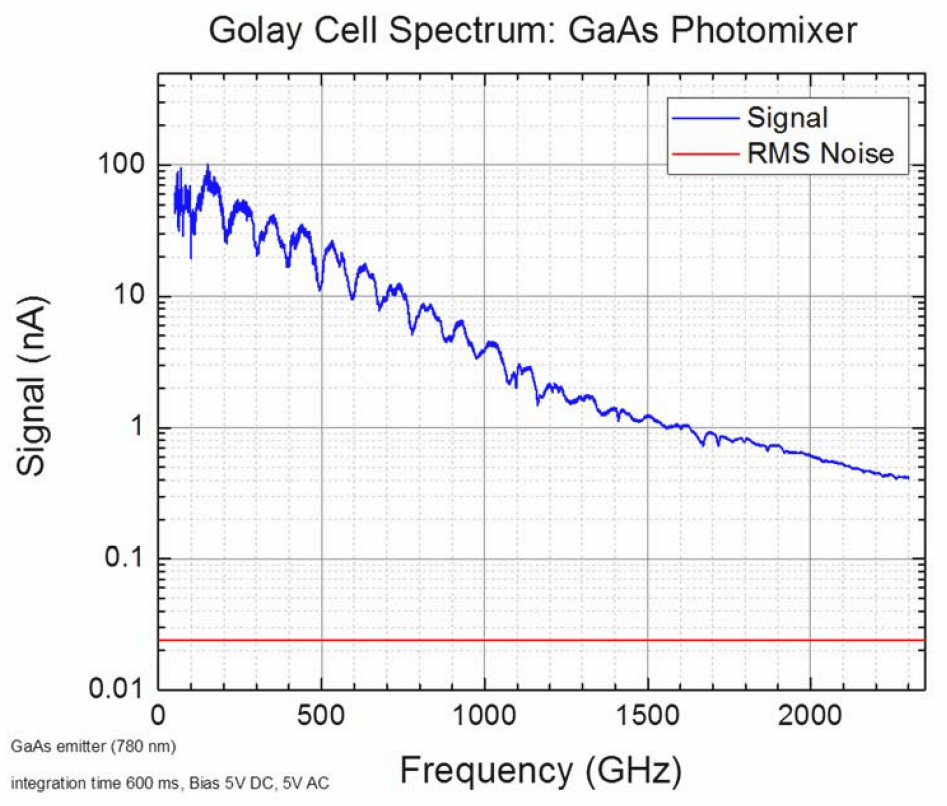
Figure 2 presents the same measurement setup using a Golay Cell detector for reference. While Golay Cells are known for flat response across THz frequencies, they are extremely slow and not suitable for many applications. ACST’s A1 detector was designed to offer similar or better responsivity, but with much faster response times—making it ideal for dynamic THz testing and screening.
Figure 1
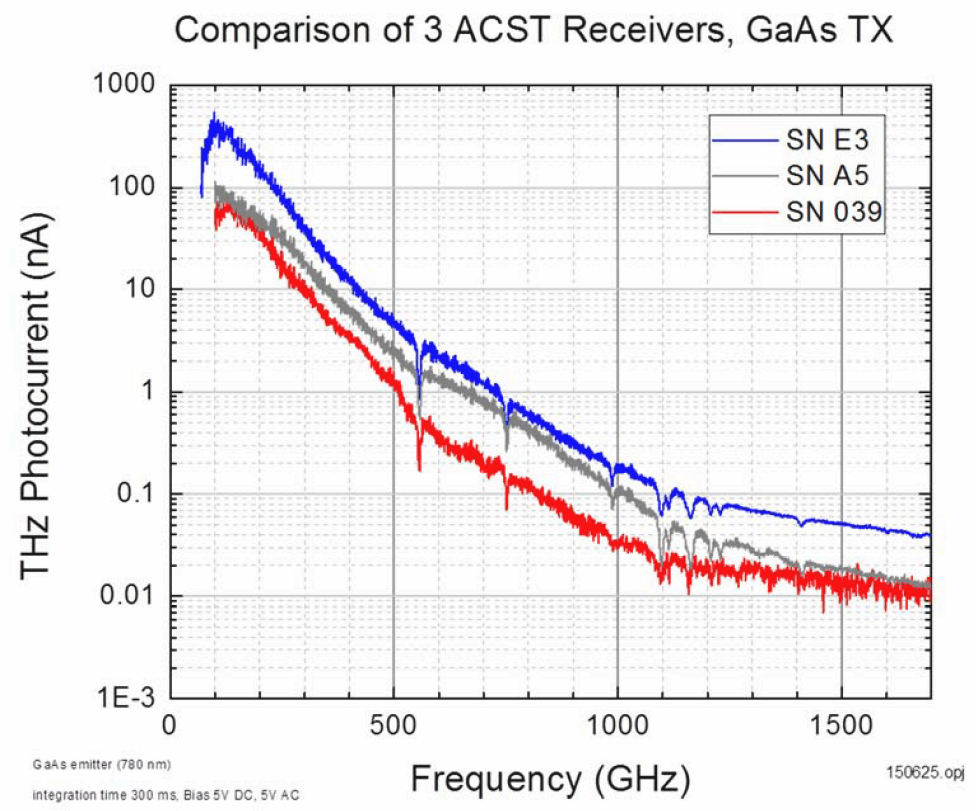
Figure 2